
Why vaccine hesitancy persists and how to talk about it
A Radio‑Canada interview, full English transcript, and a sneak peek at the 2025 edition of A Practical Guide on How to Talk About Vaccination

It’s National Immunization Awareness Week (2025), and to ring it in, CommsRx and Lê & Co. Health Communication Santé founder Maxime Lê had the opportunity to explain why vaccine hesitancy is still present and why we’re seeing increases in preventable diseases in North America during an interview segment on Radio-Canada’s show Sur le vif.
The interview, originally in French, can be heard in full on the Radio-Canada website.
In case you do not understand French, CommsRx has taken the time to transcribe and translate the information to English, since Maxime also shared a sneak peak of “A practical guide on how to talk about vaccination” that was introduced in this interview, which is being updated for 2025.
It’s meant for healthcare professionals and anybody who is looking for communication strategies to talk to people who have questions around vaccination.
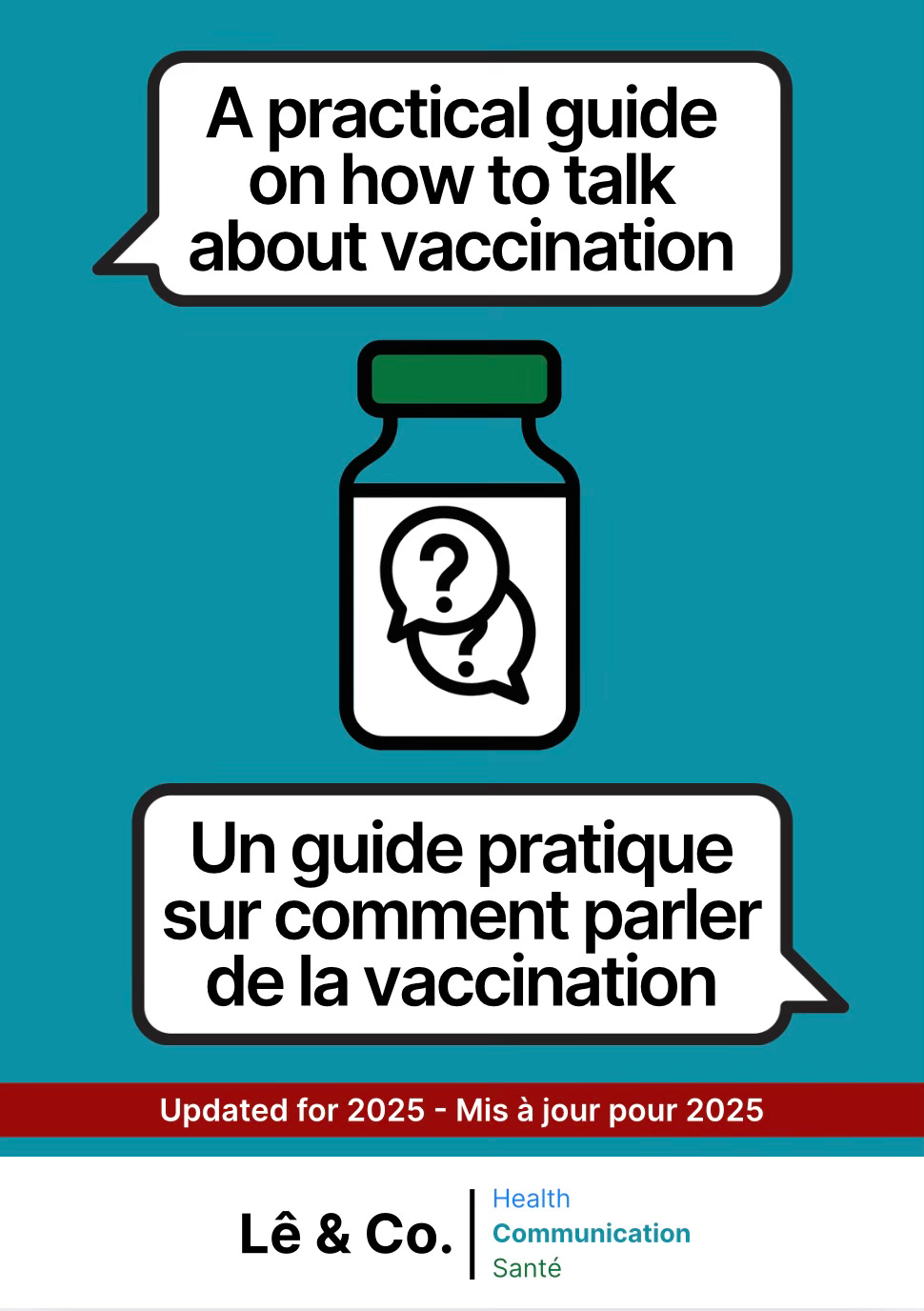
The guide, available in French and English, can be requested at:
www.le-co.ca/publications
We hope you will find the information useful. But before you continue…
🎙 English translation of the interview transcript
10m30s – National Immunization Awareness Week segment, Ici Radio-Canada Première (“Sur le vif”)
Host (Hugues Beaudouin-Dumouchel):
This year’s National Immunization Awareness Week begins under a cloud of concern: measles is spreading in Ontario. The south of the province is most affected, but as people move around, so do diseases.
To put things in perspective: Ontario reported more measles cases last week than in the entire decade from 2013 to 2023 combined.
The province’s Education Minister, Paul Calandra, has also raised concerns: some students haven’t received all the legally required vaccines, leading to school suspensions in certain districts.
So the question is: how do we raise awareness when diseases like measles are making a comeback?
Joining us to discuss is expert and health communication consultant Maxime Lê. Hello!
Maxime:
Hello, and thank you for having me.
Q1. Why is it still so difficult to convince people to get vaccinated, even for diseases we thought were long gone?
Maxime:
This challenge actually predates the invention of vaccination itself in 1796. From the start, we’ve had to work to convince people to immunize against infectious diseases — and we’re still doing it today.
One major factor is the long-term erosion of public trust in health authorities. While the dominant view tends to be pro-vaccine, there’s always been a portion of the population who refused. And over time, the arguments from anti-vaccine voices have evolved — they’ve adapted to new contexts.
Host: Like a virus, in a way.
Maxime:
Exactly. Like a virus, anti-vaccine arguments mutate and adapt to their context. But surprisingly, our counter-arguments haven’t evolved at the same pace.
Pro-vaccine information online is often technical, scientific — it’s hard to understand. Simplifying that content is the job of public health professionals and medical professionals. But with declining trust in those institutions, people are turning to alternative sources — influencers who speak in simple language and use cultural references people understand and trust.
The problem is that the information they share doesn’t always align with the scientific consensus.
Q2. What can public health authorities do?
Maxime:
In my experience, one of the most effective strategies is individual conversations. Sharing medical information clearly is important — but just as important is building trust in the process.
A lot of people get their information from Facebook, Instagram, or TikTok or other sites. They trust the people posting content there. But it’s different when the message comes from a nurse or a doctor — sometimes, those voices aren’t trusted in the same way.
One reason is fatigue: people are tired of public health experts repeating “Go get vaccinated” without taking time to truly listen to. They want someone who hears their real concerns and questions.
Online, anti-vaccine voices engage in one-on-one conversations. They pay attention to people’s concerns — not necessarily to answer them accurately, but they use these concerns to amplify fear and resistance.
For example, someone with a minor question about vaccines might quickly be led to believe that vaccines are dangerous or that their rights are being threatened. But that’s not the case.
Q3. Lately we’re hearing a lot about freedom of choice, bodily autonomy… those kinds of arguments. That’s a shift, isn’t it?
Maxime:
It is. And it’s one of the most effective strategies the anti-vaccine movement has used — both historically and now.
They tend less and less to contest the science nowadays. Instead, they focus on rights and freedoms. That’s a powerful position — because no one wants to say, “Yes, we should take away people’s freedom to choose.”
It’s a rhetorical strategy that taps into deeper emotions like injustice — and that can really resonate with people.
Q4. Who should public health be focusing on?
Maxime:
Public health efforts shouldn’t target the extremes — the hardline anti-vaxxers that have already made their choice.
They should focus on the movable middle: people with legitimate questions, people who are unsure.
These are people who want honest, respectful conversations. And that’s completely normal. We ask questions about everything — especially when it comes to our health.
The key is to support people, to provide clear, honest, transparent answers: here are the benefits, here are the risks, here are trustworthy sources. Then we invite them to make their own informed decision — not force one on them.
Q5. You’ve written a practical guide about how to talk about vaccines. Who is it for?
Maxime:
I wrote it in 2021 and I’m updating it for 2025. It’s meant for healthcare professionals — but really, it’s for anyone who wants communication tools to help build trust.
The approach is built around three steps:
Listening. It sounds simple, but it’s the most important. Take the time to ask questions and really hear the answers.
Tactical empathy. Use communication techniques to acknowledge and validate the other person’s feelings. Show that you respect their ability to decide for themselves.
Equipping. Give them credible information and tools — so they can do their own research and make a choice they feel good about. Then, support them in that decision.
Interested in the guide?
To request a copy of “A practical guide on how to talk about vaccination”, visit:
www.le-co.ca/publications